
For some of us, we may not be as familiar with traditional Korean art as we are with Korean food, music other cultural elements. As such, I hope to introduce and provide you with a quick guide on how to understand and appreciate traditional Korean paintings, which you will soon realize is quite different than the way we look at Western paintings like Da Vinci’s Mona Lisa or Monet’s Impression, Sunrise.
In sum, there are 6 unique points that you should remember when looking at traditional Korean paintings. Let’s find out what they are:
1. Traditional Korean paintings are designed to be seen and read alike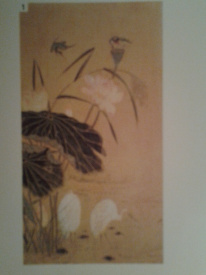
When looking at traditional Korean paintings, you need to look beyond the colours, the drawings, and the texture – you need to read them as if it was a piece of writing. What does this mean? Take a look at “일로연과도” on the right. Standing below the lotus is a white heron, known as “일로 (一鷺, 한 마리의 백로)” in Korean. Also, at the top of the lotus flower is its bee-hive shaped fruit, which is referred to as “연과 (蓮菓)” meaning lotus fruit in Korean.
But there is a catch: “일로” has the same pronunciation in Korean as “일로 (一路)” which means “in first attempt,” while “연과” has the same pronunciation as “연과 (連科)” which means to pass the national civil service exam. Hence, this painting was intended to be given as a gift to students who were leaving to take the national civil service exam: “I hope you pass the exam in your first attempt!” An unusual gift? Of course not, even today, we give our students little gifts to wish them good luck on their exams. As such, many traditional Korean paintings carry messages like the one in “일로연과도” and the key to finding them is to read the painting as if it was a piece of writing.
2. Traditional Korean paintings need to be seen from right to left, top to bottom.
Today, we are used to the Western way of reading: from left to right, in horizontal lines. As a result, when we look at paintings, we cannot help ourselves from viewing them in this same direction. This does not cause a problem with regards to Western art; however, we cannot look at traditional Korean paintings in the same manner. Why? Let’s take an example:
Take a look at “주상관매도” on the right. If you look at it in this direction, , the Western way, there is a feeling of uneasiness and obstruction. This is because it contra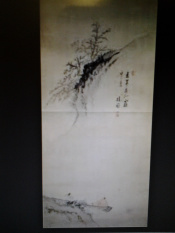 dicts with the natural flow of the painting. On the other hand, if you look at it from right to left, as in accordance with the way books were read in traditional Korea – in this direction , you should be able to get a more natural feel with a strong sense of realism attached. Indeed, a small change in how you look at traditional Korean paintings can help you understand the true effect of their design, form and structure.
3. Korean paintings are imbedded with jokes and humour
Given the strategic location of the Korean peninsula, the Korean people have witnessed and endured a history of war and foreign invasions. However, despite these times of hardships, the Korean people have not lost their spirit and joy.
As we learn about traditional Korean paintings, sometimes we find ourselves smiling without exactly knowing why. “낙마도” on the bottom right, and “담배를 피우는 호랑이” on the bottom left, are paintings 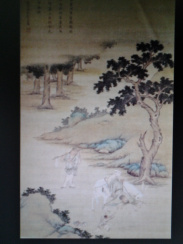 that cause us to smile as such. Particularly the latter painting is very humorous and funny: a tiger that smokes a cigar is a very popular figure in Korean folk tales.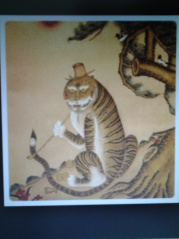
Also, the former painting captures the moment when an old professor is falling off his donkey. A student rushes toward his teacher while a passer-by quietly smirks from behind, reveling in the amusing scene that has just unfolded in front of him.
Perhaps with help from these cheerful paintings, the Korean people were able to maintain their sense of humour and joy during times of war and hardships.
4. When looking at traditional Korean paintings, you need to feel the mood of the paintings as well
Traditional Korean paintings are not only seen but also felt as they allow the onlooker to feel the mood of the paintings. Take a look at “수향귀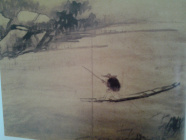 주도.” In this painting, there is a fisherman on a canoe floating on the river. In one respect, this painting could be judged as being a bit boring. Then again, try to feel the calm mood created by the simple yet pristine nature surrounding this fisherman on the canoe. The wavy brush strokes used to depict the flowing river create a sense of movement; while the stillness of the rock and plants produce an atmosphere of calm and peace. Can you feel the tranquility produced by this river scenery in the midst of which a fisherman is patiently waiting for his first catch?
5. The spirit of a scholar is imbedded in many traditional Korean paintings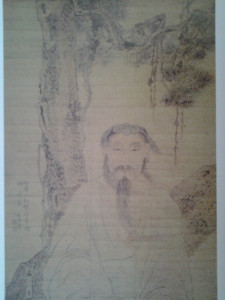
If Japan chose the sword and raised Samurais, Korea chose the quill and fostered scholars. For our ancestors, painting was a way of refining our mind and purifying our soul. Thus, it was possible from simply looking at a painting to speculate the character and personality of the painter. “검선도” on the right shows a scholar whose image suggests an unfaltering stance towards scholarship. Turning his back on money and fame, he has lived a life devoted to learning and research, a life of high moral expectations, a life guided by the spirit of a scholar.
6. Finally, traditional Korean paintings need to be seen again and again in order to fully appreciate their true meaning
At first, traditional Korean pain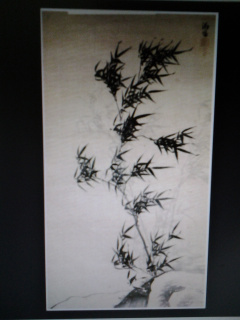 tings can seem remote and unfamiliar. “풍죽도” on the left may be difficult to understand at first glance: what could be the significance of the bamboo grove? But as you become more familiar with traditional Korean paintings, you will be able to appreciate and enjoy the true meaning of art of Korea.
And to help you with this challenge, stay tuned for my next blog in this Art of Korea series as I will be introducing to you the works of the most famous painter of the Chosen Dynasty, Kim, Hong-do.

Categories: 2013
